Aladdin Autoengineering Corporation
The Door into SummerAladdin Autoengineering Corporation is the manufacturer that turns household and workplace automation into a commercial product line—and, for Dan Davis, a living trace of engineering work he believes was taken from him. Its devices connect the early Hired Girl and Flexible Frank to a later generation of machines, while its Drafting Dan makes the company’s history feel less like a simple story of invention than a collision between technological inheritance, lost time, and the distinctive choices of a designer.
Products and Technical Approach
The company’s product range is presented through an instruction sheet encountered by Dan in a hospital. It identifies Aladdin Autoengineering Corporation as the maker of Eager Beaver, Will! Wa W, Drafting Dan, Builder Bill, Green Thumb, and Nanny, and offers custom design and consulting for automation problems. The accompanying trade mark shows Aladdin rubbing his lamp as a genie appears, while the slogan presents the company as being at the customer’s service. The names and imagery frame automation as practical assistance: a range of task-specific machines rather than a single all-purpose invention.
The instruction sheet also marks a boundary between a machine’s useful responses and human understanding. The automaton it describes does not understand speech; it responds to listed spoken orders, ignores other speech, and may present the instruction sheet if a phrase triggers it incompletely or creates a circuit dilemma. The task lists include simple commands and hospital routines, but some routines are reserved for hospital staff and are not listed. The company’s devices can therefore appear responsive without being conversational agents: their competence depends on carefully specified instructions and controlled access to functions.
That distinction reflects the design principles behind Flexible Frank. Dan explains that Thorsen memory tubes can record an operation demonstrated through manual control, then direct a machine to repeat it without supervision. A separate hunting circuit can search within defined limits and interrupt the recorded instruction when the situation does not match the original cycle. This arrangement allows a machine to handle recurring tasks such as clearing dishes and loading a dishwasher, while keeping its apparent “judgment” within programmed bounds. Aladdin’s later voice-controlled equipment represents a development in usability, not evidence that its machines possess human understanding.
Inheritance from Hired Girl and Flexible Frank
Dan’s account of Hired Girl stresses that the invention depended less on wholly new components than on combining existing ones. He adapted a prowl pattern from the “Electric Turtles” described in Scientific American, used a memory circuit from a guided missile, and assembled cleaning mechanisms and linkages from such sources as an army-hospital floor polisher, a soft-drink dispenser, and equipment for handling radioactive materials. In his telling, the novel achievement lay in the arrangement and in securing a patent, rather than in claiming that every element was unprecedented.
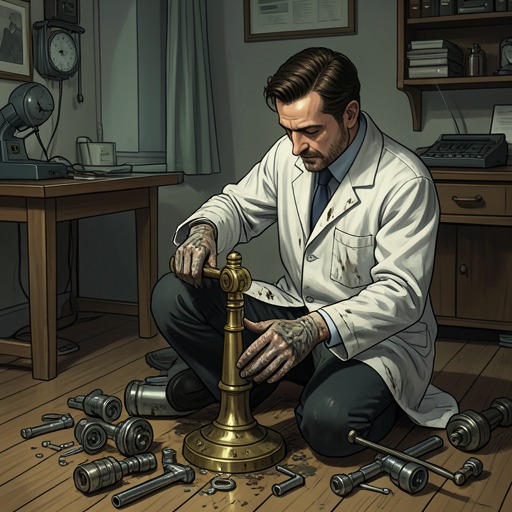
Production engineering made that combination commercially viable. Most parts could be ordered from a catalogue; the exceptions were two three-dimensional cams, which Dan made himself with war-surplus automated tools, and a printed circuit subcontracted elsewhere. Dan and Miles Gentry initially assembled the machines by hand. The pilot model cost $4,317.09, whereas the first hundred cost just over $39 apiece. They sold them to a Los Angeles discount house for $60, where the retail price was $85. Consignment sales, lack of promotion money, and the founders’ near-starvation preceded a turning point when Life ran a two-page feature and demand required additional assembly help.
The commercial venture became an organization as the work expanded. Belle Darkin joined as a typist and bookkeeper; the business rented an electric typewriter, designed letterhead, and eventually incorporated. Dan retained 51 percent of the shares and served as chief engineer and chairman of the board, while Miles was president and general manager and Belle secretary-treasurer. Dan’s explanation makes the division of authority explicit: he had supplied most of the savings and all of the engineering inventiveness, while Miles brought business ability. That history helps clarify why later machines made by another company could carry such personal weight for him: the products were inseparable from the design labor and control over its results.
The Successor Frank and Dan’s Recognition
When Dan encounters an Aladdin hospital automaton after waking in the future, he recognizes Flexible Frank’s lineage. The machine adjusts his built-in bed table, opens it, and arranges breakfast. Dan asks it to pour his coffee not because he wants the coffee poured immediately, but because he wants to see the action. In the polished device he recognizes the evolution of his own work: not the crude first model that Miles and Belle had taken from him, but a greatly improved descendant built on the same basic pattern.
The recognition is sharpened by the patent plate. Dan expects to find Hired Girl, Inc. named on the instruction notice and wonders whether Aladdin might be a subsidiary of the Mannix group. Instead, the plate lists about forty patents, with the earliest dating from 1970. He takes down its number because he believes the patent is almost certainly based on his original model and drawings, although he judges that it has expired. His response combines a claim of dispossession with a practical awareness of patent terms: the past’s apparent theft may be historically consequential without giving him a current legal right to the invention.
The company’s presence in this scene is therefore both ordinary and uncanny. Its machine performs an everyday service in Dan’s hospital room, but that service makes the decades between his work and the future materially visible. The improved Frank demonstrates that the underlying design has endured; the patent date suggests a route from his 1970-era invention to later commercial production, even though the supplied account does not establish the full corporate history or ownership chain.
Drafting Dan and the Designer’s Signature
Aladdin’s Drafting Dan gives Dan a second, more disturbing encounter with his own engineering instincts. He has seen pictures of powered, semiautomatic drafting machines and privately believes he could learn to operate one quickly. He had independently imagined a device that would place lines and curves on an easel through keystrokes, in much the way a typewriter turns keys into written text. But he distinguishes that unrealized idea from Flexible Frank: because he had never built the drafting machine, he does not believe the concept was stolen.
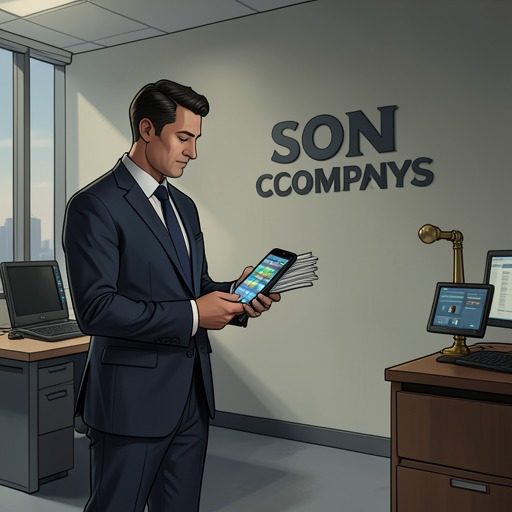
To investigate, Dan spends from his savings on a better suit and a secondhand briefcase, stuffs the case with newspapers, and goes to Aladdin’s salesrooms pretending to be a prospective buyer. When he approaches Drafting Dan, he experiences déjà vu. The machine has been developed in precisely the fashion he thinks he would have chosen had he not been kidnapped into the Long Sleep. The resemblance unsettles him not because he can point to a stolen drawing, but because the solution carries the feel of his own method.
Dan describes engineering as an art in which a designer’s choices mark the work, just as an artist’s brushwork, treatment of light, composition, and pigment can identify a painting. Drafting Dan becomes evidence of convergence rather than proof of theft: someone else has arrived at a design that bears the signature of choices Dan recognizes as his own. The episode gives Aladdin’s product line a second kind of significance. Its machines do not merely extend a practical technology; they expose how similar problems can produce parallel designs, and how lost time can make independent development feel like an encounter with one’s displaced self.
Development and Significance
After returning to 1970, Dan sets up a small workshop and decides to build Drafting Dan before rebuilding Flexible Frank. He broadens the latter into Protean Pete, an all-purpose automaton capable of many tasks if its Thorsen tubes are properly instructed. Dan expects that this general-purpose design will eventually divide into specialized descendants, and he makes the patent claims as broad as he can. The choice connects his earlier work to the specialized commercial machines associated with Aladdin while showing him deliberately shaping both a platform and its future offshoots.
Dan’s account also makes clear that an invention’s success depends on more than an inventor’s idea. He wants working models that can demonstrate their reliability and commercial value, not merely designs that satisfy patent requirements. Without a proper machine shop or help, progress is slow; renting tools improves the pace, and standard catalogue components make construction possible. He works toward demonstration-ready machines before preparing drawings and descriptions. This emphasis echoes the early Hired Girl story, where production costs, available parts, sales arrangements, and publicity determined whether a working device could become a viable product.
Aladdin Autoengineering Corporation thus serves as a focal point for the book’s contrast between invention and industrial realization. Its devices embody accumulated design, manufacturing, and interface choices; their apparent intelligence remains bounded by programmed routines, while their practical usefulness depends on engineering and production systems. For Dan, the company’s products make the consequences of his lost years tangible: Flexible Frank’s recognizable descendant and Drafting Dan’s uncanny parallel both show that technological work can outlast its creator, while leaving questions of authorship and ownership unresolved.